
For the last couple of years, marketers have worried that artificial intelligence and changes to Google’s platform would erode organic website traffic, creating gaps in marketing budgets already strained by new online advertising channels and rising CPCs.
The Q1 2026 Datos State of Search study reveals the surprising reality. For marketers, stories of complete digital disruption caused by AI lack observable truth. The fundamental concepts of SEO remain largely intact, but, as always, change is ever-present.
As brands begin to hunker down to hash out 2027 strategies, this is what the latest data tells us.
1. The Zero-Click Threat is Retreating (For Now)
For years, Google has been growing into a final destination rather than a gateway, keeping users on-platform via featured snippets and instant answers, hoping they click those money-making ads. The latest data breaks this trend in a very meaningful way. Zero-click searches are in retreat. Google is sending more traffic to websites than before.
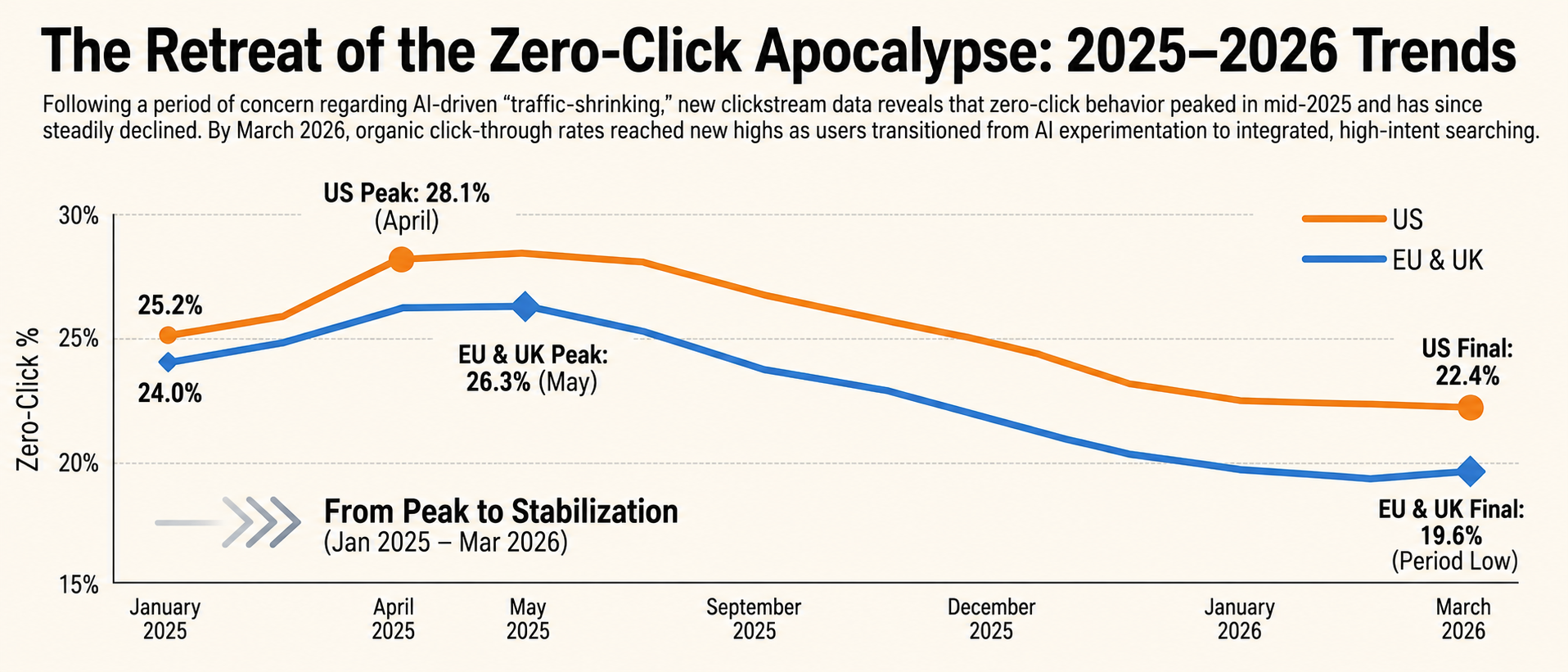
- The Data: Zero-click searches in the US actually decreased to 22%, the lowest level since 2024. At the same time, organic clicks to the open web climbed to 45% in Q1 2026 from 42% in December 2025.
- The Takeaway: Do not let AI hype destroy your strategy. Traditional SEO and high-quality content investments remain some of the most direct, viable levers for driving qualified website traffic.
2. Where People Search is Still a Monopoly
Despite the hearsay, Google’s dominance is unchanged.
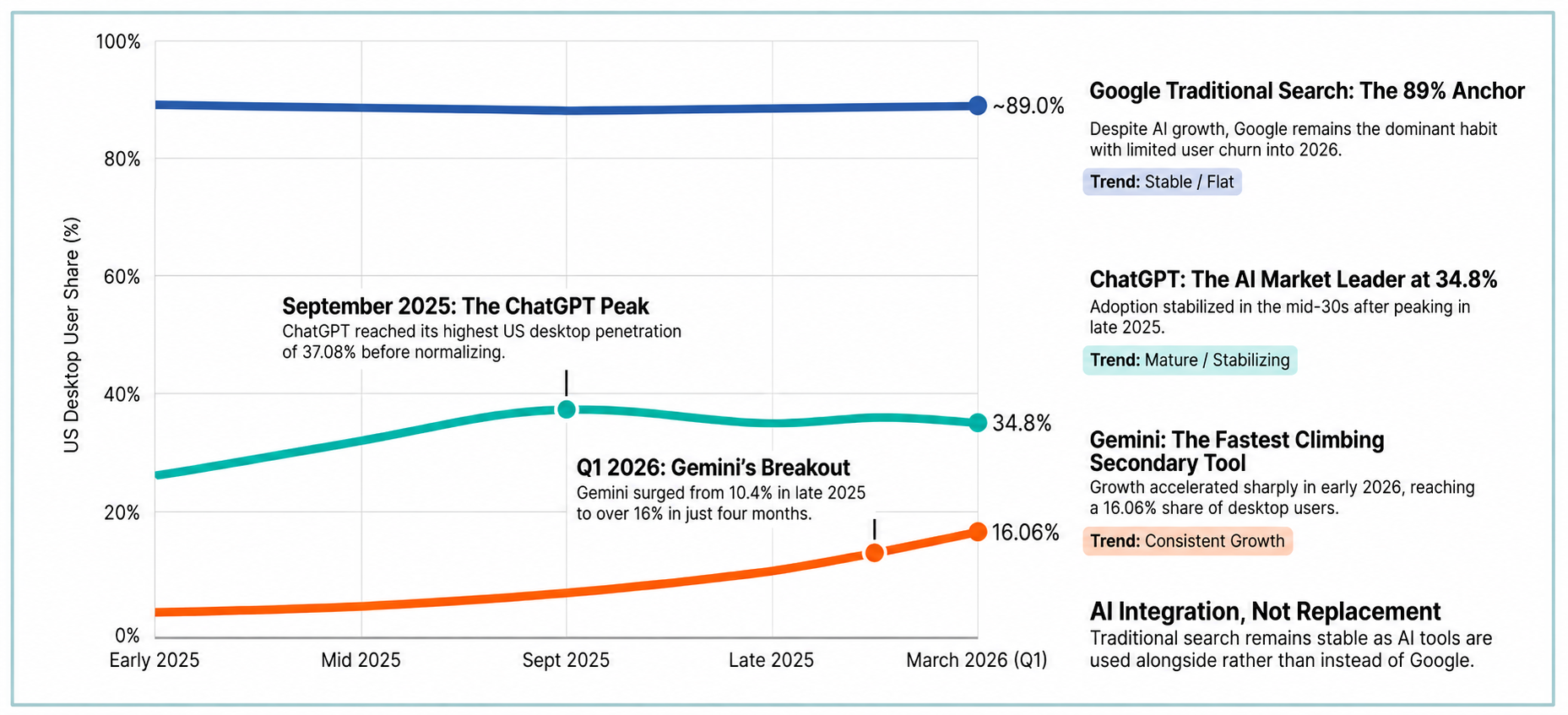
- The Data: By March 2026, Google held approximately 89% of US desktop search users and commanded 94% of total US search volume.
- The Takeaway: Do not run from traditional search engine marketing (SEM/SEO) to chase shiny new channels. Google remains the primary driver of online discovery for consumers by an enormous margin.
3. If You’re Eyeing ChatGPT, Don’t Forget about Google Gemini
If your AI visibility and optimization strategy is focused exclusively on ChatGPT, you are already behind. The US AI tool landscape has changed significantly in Q1 2026. Don’t sleep on Gemini!
- The Data: ChatGPT is currently the US market leader, but its growth seems to be plateauing, with the platform capturing 35% of US users. Google Gemini has solidly established itself in second place at 16% with a sudden acceleration in early Q1 2026.
- The Takeaway: Two billion people encounter AI via Google, compared to 250 million via ChatGPT. The smart money is on Google to take the AI chatbot throne.
4. Americans are Searching in Full Sentences
There is a structural shift in how Americans seek information, driven by more conversational habits.
- The Data: Mid-length queries of 6–9 words and longer queries of 10+ words are both growing. Also, informational intent on Google has risen to nearly 65% of all queries.
- The Takeaway: Stop agonizing over individual keywords. That data has been directional for some time. Think about collections of keywords, aka topics. Users are becoming more precise, detailed, and demanding. CMOs should audit their content libraries against the specific, complex questions their audiences are actually asking, rather than the abbreviated keyword proxies of the past.
The Bottom Line
The best practices that have driven organic growth for years, quality content, technical SEO, and a clear understanding of user intent, remain effective in the AI era.
As it has since the earliest days of SEO, the search ecosystem continues to evolve. AI search is split between ChatGPT and a rapidly growing Google Gemini. Queries continue to grow longer and more conversational, and this demands topical depth over basic keyword strategy.
The brands that will win in 2027 are not the ones who panicked to chase unproven channels, nor the ones who ignored AI completely. The winners will be the brands that studied the data, doubled down on what works, and began to position themselves strategically for the AI search experience that is still taking shape.